
Experienced Digital marketers watched a campaign spend money for several days before anyone noticed the real problem: the ads were getting clicks, but the landing page was sending people somewhere completely different from what the ad promised.
Nothing was technically broken. The campaign was live. The ads were approved. Traffic was coming.
And yet, it was wasting money.
That experience is a reminder that launching an Any Ads campaign is not about pressing the publish button. Experienced digital marketers check what happens when before the first click ever costs a dollar.
Start With the Goal, Not the Keywords
One of the first questions I ask is simple: What should this campaign actually achieve?
More phone calls? Lead forms? Online purchases? Brand awareness?
The answer affects everything from campaign structure to bidding and conversion tracking. Google recommends building campaigns around clear objectives other than mixing different target into one campaign.
A campaign designed to generate leads should not be judged purely by clicks. Ten highly relevant visitors can be worth more than 500 people who never had any intention of buying.
Check Search Intent Before Building the Campaign
This is where SEO Services thinking can be surprisingly useful.
SEO and paid search are different channels, but both require an understanding of what someone actually means when they search.
A keyword such as a digital marketing agency can represent very different intentions. Some people are researching agencies, comparing prices, looking for a local provider, or preparing to hire one.
Before launch, I want to know:
- What does the searcher expect to find?
- Is the keyword commercial or informational?
- Does the offer actually match that intent?
- Are there obvious irrelevant searches that should be excluded?
Google recommends grouping related keywords into tightly themed ad groups and using search-term data to identify irrelevant queries and negative keywords.
Is the Ad and Landing Page Tell the Same thing
If an ad says Book a Free Consultation and the visitor lands on a generic homepage with no obvious way to book anything, the campaign has created friction before the sales process even begins.
Google specifically recommends matching the landing page to the ad and keyword, including aligning the page’s call to action with the promise made in the ad.
I also check the page on my phone. A beautiful desktop page doesn’t help much if the mobile version loads slowly or makes the contact button impossible to find.
Look Beyond Copy With Video Editing and Creative Testing
Search ads aren’t the only place where creative thinking matters.
For campaigns running across YouTube, Display, Performance Max, and other visual platforms, effective video editing can directly influence ad performance. Even a professionally produced video may struggle to hold viewers’ attention if the opening seconds fail to capture their interest.
I prefer testing different hooks, messages, visuals, and calls to action rather than assuming one perfect creative will carry the campaign.
That same principle applies to AI Video Ads. AI makes it faster to make variations, but speed does not replace strategy. Producing more videos doesn’t guarantee better results.
Check Conversion Tracking Before Spending Anything
This is probably the least exciting part of campaign setup and one of the most important.
Before starting, I really want to know exactly what counts as a conversion and whether the action is being recorded correctly or not.
That might be:
- A completed lead form
- A phone call
- A purchase
- A booking
- A valuable sign-up
Google Ads provides conversion and cost-per-conversion data to help advertisers understand whether campaigns are producing business outcomes, not just traffic.
If tracking isn’t reliable, optimization becomes guesswork.
Think About What Happens After the Click
A Google Ads campaign doesn’t operate in isolation.
The website, follow-up process, social presence, and content all influence what happens next. Strong Social Media Marketing can reinforce credibility when someone searches for the business after seeing an ad.
That’s why I like to look at the entire customer journey rather than treating paid advertising as a separate box.
FAQs About Launching Google Ads Campaigns
Things I should check before launching Google Ads campaign?
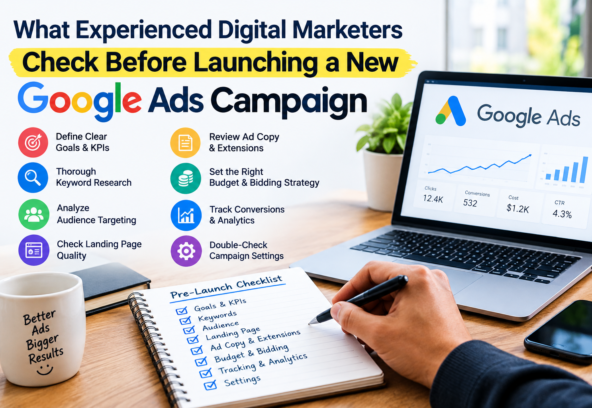
Check the campaign goal, audience, keyword intent, negative keywords, ad copy, conversion tracking, landing page, budget, location targeting, and mobile experience.
How many ads should I test?
There isn’t one universal number, but testing multiple relevant variations gives Google more creative options to evaluate. Google recommends providing multiple headlines and descriptions for responsive search ads.
Do I need SEO if I’m running Google Ads?
SEO and paid search can work well together, even though they serve different purposes. SEO helps a website gain organic traffic over time, while Google Ads can put a business in front of potential customers who are actively searching for its services.
Are AI Video Ads worth using?
They help teams create different versions of their content quickly and see which ones perform best.The important part is still the message, audience, offer, and editing not simply the fact that AI created the video.
The Best Campaigns Usually Start Before Launch Day
A campaign can be technically perfect and still fail because the strategy behind it was rushed.
Experienced marketers look at the searcher’s intent, the offer, the landing page, the tracking, the creative, and what happens after the click.
That preparation may not look exciting in a dashboard. But it is often the difference between paying for traffic and paying for results.